2025 M4 Mac Mini Rental: Building Private AI Visual Labs Without Thermal Throttling
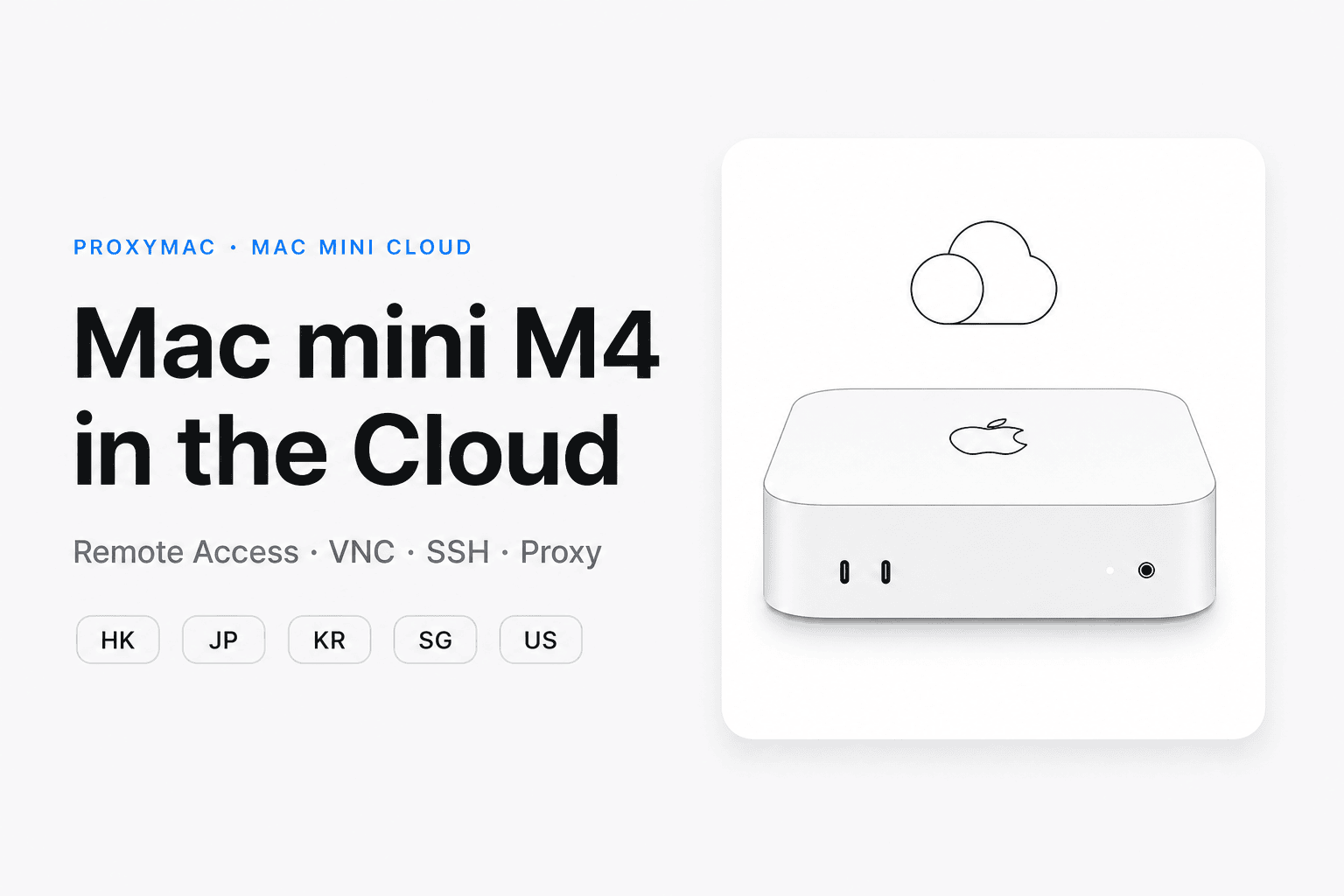
The 2025 Shift: Why Local Hardware Fails the AI Vision Test
By 2025, the release of Anthropic’s "Computer Use" and similar AI agentic frameworks has officially moved AI from text boxes to visual interfaces. Unlike LLMs that process tokens, these agents must continuously capture high-resolution screenshots, perform Optical Character Recognition (OCR), and execute GUI reasoning. Running these 24/7 on a local machine is a recipe for hardware disaster.
If you are an AI developer or an automation engineer, you have likely encountered these three obstacles:
1. Thermal Throttling: Sustained GPU and Neural Engine usage causes local MacBooks to heat up quickly, forcing the system to downclock and slowing your AI's reaction time.
2. Persistent Uptime Requirements: AI agents designed for "Computer Use" need to stay active 24/7. Keeping a personal laptop awake for weeks ruins battery health and creates a fire hazard.
3. Bandwidth Bottlenecks: High-frequency screen analysis requires massive memory bandwidth. Local consumer-grade machines often share this bandwidth with your IDE, browser, and background apps, leading to stuttering.
A professional M4 Mac mini rental solves these issues by moving the heavy lifting to a temperature-controlled, high-performance cloud environment. By utilizing proxymac.com, you get a dedicated node designed specifically for these high-load scenarios.
Thermal Management: Cloud M4 Nodes vs. Local MacBook Pro
The M4 chip is a powerhouse, but Apple’s thin laptop chassis are not designed for the 100% sustained utilization required by an AI vision model acceleration pipeline. When an agent analyzes 2-5 frames per second to navigate a complex Web3 dashboard or a legacy CRM, the SoC temperature frequently crosses the 90°C threshold.
| Metric | Local MacBook Pro (M4) | Cloud M4 Mac Mini (Dedicated) | Why It Matters for AI |
|---|---|---|---|
| Sustained Clock Speed | 2.8GHz - 3.4GHz (Fluctuates) | 4.4GHz (Stable) | Prevents latency spikes in GUI reasoning. |
| Cooling Profile | Passive/Small Fan (Aggressive Throttling) | Enterprise-grade Airflow (No Throttling) | Ensures consistent FPS for screen capturing. |
| Memory Bandwidth | Shared with UI & Apps | Dedicated to Agent Tasks | Increases visual analysis speed by up to 40%. |
| Power Supply | Battery/Adapter (Heat source) | DC Enterprise Power | Eliminates risk of battery swelling. |
| Deployment Cost | $1,599+ Upfront | Low Monthly Fee | Predictable 2025 AI infrastructure rental costs. |
The M4's Neural Engine is optimized for CoreML, but it requires cold air to maintain peak throughput. In a cloud facility, your instance runs in an environment where the ambient temperature is strictly maintained, allowing the M4 to maintain its maximum boost clock indefinitely.
Building Your 24/7 AI Private Vision Lab
Most vision-based AI projects, such as macOS automation testing or automated competitive intelligence gathering, fail because of "environment drift" on local machines—updates, sleep modes, or Wi-Fi drops interrupt the agent.
A cloud-based lab provides a "Silent Node." For example, a team building a visual scraping agent for e-commerce can deploy on an M4 node and let it run for months without touching it. This is the core advantage of ProxyMac cloud Mac architecture: it provides a persistent workspace where the GUI session is never closed, even if you disconnect from your local client.
The efficiency of the M4 chip in visual tasks is backed by the Apple Silicon Documentation, which highlights the unified memory architecture's ability to feed high-resolution images directly from the GPU to the Neural Engine without copying data across a PCI bus. This reduces "Computer Use" latency by hundreds of milliseconds compared to standard cloud VMs with attached GPUs.
5 Steps to Configure Your M4 Mac Mini Rental for AI Vision
Setting up an environment for Anthropic "Computer Use" or macOS automation testing requires specific configurations to handle remote visual feedback.
1. Provisioning Your Node
Log into your console.html and select the M4 Mac mini image. Ensure you select at least 16GB of RAM, as vision models are memory-hungry.
2. Optimizing Remote Display
For AI agents to "see" clearly, the virtual display must be stabilized. Use a "dummy plug" configuration (standard on most M4 cloud rentals) to set a fixed resolution like 1920x1080. Avoid non-standard aspect ratios that might confuse the AI vision model's coordinate system.
3. Permissions and Accessibility
Since AI agents need to control the mouse and keyboard, navigate to System Settings > Privacy & Security > Accessibility. You must grant permissions to your terminal or the agent’s runner application. In a cloud environment, this is done via a remote desktop session.
4. Setting Up the Computer Use Running Environment
Install the Computer Use running environment using Docker or a native Python virtual environment. We recommend the native approach to leverage the M4's metal acceleration directly.
# Example check for Metal Support
system_profiler SPDisplaysDataType | grep Metal
5. Persistent Session Management
To ensure your node doesn't stop when you log off, use a persistent VNC or use a tool like Screen or Tmux for the backend logic, but keep the GUI logged in. This allows the AI agent to continue interacting with the "window server" even when you are asleep.
Avoiding Common Pitfalls in Cloud AI Deployment
Running AI on a remote Mac is different from a standard Linux VPS. Here are technical hurdles you must watch for:
- Screen Recording Permissions: macOS requires explicit user consent for an app to record the screen. If you are using a headless M4 rental, ensure you have set these permissions via a VNC session before starting your 24/7 scripts.
- Idle Timeout: macOS may try to put the machine to sleep if no human interaction is detected. Use the
caffeinatecommand in your terminal to keep the visual lab active:caffeinate -u -t 3600 &. - SIP (System Integrity Protection): For advanced automation, some developers try to disable SIP. We advise against this; most modern AI agents can operate within standard security bounds as long as the Accessibility permissions are correctly handled.
For more details on managing your instance, check our help.html section.
Why Renting Beats Buying for 2025 AI Labs
The speed of AI evolution makes hardware ownership a liability. The M4 Pro might be the king today, but the M5 will arrive in 12 months. When you purchase hardware, you are locked into that performance tier and responsible for its maintenance, physical security, and electricity costs.
Current local solutions for AI agents are often inefficient. A typical developer's MacBook Pro is cluttered with apps, making it an "unclean" environment for testing. Furthermore, a local machine is subject to household power outages or Wi-Fi hiccups. In contrast, an enterprise-grade cloud Mac provides a clean, high-bandwidth environment that is accessible from any iPad, Windows PC, or older Mac.
Transitioning to a M4 Mac mini rental allows you to scale your vision lab instantly. Instead of one expensive laptop, you can spin up five M4 nodes for parallel testing of different AI models.
Stop struggling with overheating laptops and throttled performance. Start your pricing-hongkong.html trial today and experience the stability of a dedicated M4 node for your AI visual laboratory.
FAQ
Further Reading
Scale Your AI Development with Proxymac
Deploy high-performance M4 Mac mini nodes instantly via our global data centers in the USA, Japan, and Hong Kong.
Eliminate local hardware thermal throttling with dedicated Apple silicon hosting designed for 24/7 AI model inference.