Cloud Mac Rental vs Buying a Mac in 2026: Which Should You Choose?
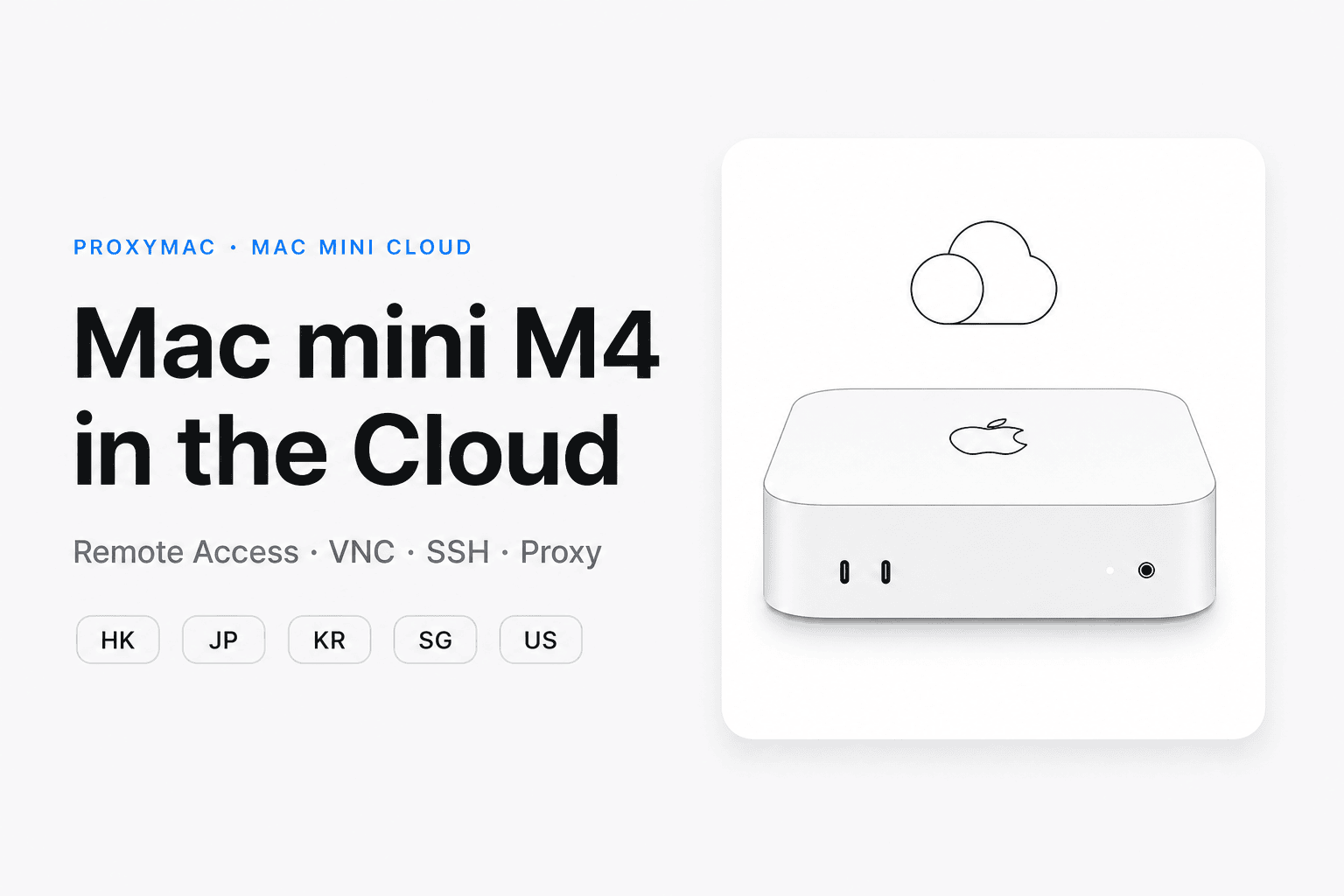
If you need an always-on AI assistant, automation worker, or macOS CI runner, cloud Mac rental is usually the safer first choice in 2026. It avoids hardware delivery delays, reduces upfront spending, and gives you remote access without turning your office or home network into a production environment. This guide compares cloud Mac rental with buying a Mac using one decision table, a total-cost framework, deployment steps, and practical recommendations for different workloads.
1. Why cloud Mac rental is becoming the practical default
The problem is not simply that Macs cost money. The real problem is that an AI Agent deployment needs a reliable machine before it needs a powerful machine.
If you buy a Mac, you must first choose the right memory, storage, network setup, location, backup method, and remote-access method. You then wait for delivery, install dependencies, configure accounts, and test recovery. A project that looked like a one-day deployment can become a multi-day infrastructure task.
Apple is also expanding Mac mini production capacity in the United States, with production at a Houston facility planned for later in 2026. That does not guarantee immediate local availability for every configuration or region. It does show that supply and manufacturing capacity remain relevant factors in Mac infrastructure planning. (apple.com)
For a short-lived experiment, this delay has a direct cost. Your agent is not running, your CI pipeline is not testing, and your team is spending time on procurement instead of product work.
Bottom line: if the project needs a Mac this week, rent first and buy later only after usage is proven.
2. What an always-on AI Agent actually requires
A local AI Agent is not the same as running a chatbot in a browser. A persistent agent may watch a mailbox, process files, call APIs, update a repository, launch builds, monitor services, or perform scheduled tasks overnight.
That creates at least five operational requirements:
- Continuous availability: The machine must stay powered on and connected. Sleep settings, router resets, and accidental shutdowns can interrupt jobs.
- Remote access: You need terminal access for automation and graphical access for macOS applications, Xcode, Instruments, or iOS Simulator.
- Process recovery: The agent must restart after a crash, reboot, dependency update, or network interruption.
- Permission control: API keys, repository tokens, file access, and automation permissions must be separated from your personal account.
- Storage monitoring: Logs, artifacts, simulator data, caches, and downloaded models can consume storage faster than expected.
macOS provides launchd for starting and managing background services. Apple recommends using launchd for daemon and agent processes because it gives administrators a standard way to manage background jobs. (developer.apple.com)
That helps, but it does not remove the need for monitoring. A launch rule can restart a process. It cannot decide whether the process is stuck, whether it is sending the wrong API requests, or whether it has filled the disk.
3. Buying a Mac versus cloud Mac rental
Buying gives you physical ownership and complete control over the machine. Cloud Mac rental gives you dedicated remote hardware without the procurement, installation, and physical maintenance burden.
| Decision factor | Buying a Mac | Cloud Mac rental |
|---|---|---|
| Delivery | Depends on stock, shipping, and configuration | ProxyMac lists automated delivery, usually within five minutes after successful payment |
| Upfront cost | Hardware purchase, accessories, networking, and possible backup equipment | Daily, weekly, monthly, or quarterly billing |
| Hardware control | Full physical control | Dedicated bare-metal Mac with remote management |
| Maintenance | You handle macOS updates, failures, disks, cooling, and power | Provider handles the physical environment; you handle software and workloads |
| Remote access | Requires router, VPN, firewall, and wake/recovery planning | SSH and browser-based VNC are available through the management console |
| Scaling | Buy another machine and wait for delivery | Add or remove rented machines as demand changes |
| Idle cost | Hardware remains yours even when unused | Stop or cancel according to the billing period |
| Data location | You choose the physical location | You choose among available data center regions |
| Best fit | High utilization, long ownership horizon, existing operations capability | Fast launches, uncertain demand, remote teams, CI bursts, and temporary workloads |
ProxyMac currently lists a dedicated Apple M4 Mac mini configuration with 16 GB unified memory, 256 GB NVMe storage, and a dedicated 1 Gbps network connection. Its pricing page shows a daily option of $20.4, a monthly option of $101.9, and a quarterly option of $277.2 for the listed base configuration. These are current site figures and should be checked again before purchase because pricing and availability can change. (proxymac.com)
The key distinction is not “owned hardware versus rented hardware.” It is fixed capacity versus adjustable capacity.
4. How to calculate the real cost
The purchase price is only one part of the cost of self-owned Mac infrastructure. Use this formula:
Total cost = hardware + accessories + network setup + power + maintenance + backup storage + support time + idle capacity + replacement risk
For a purchased Mac, include:
- The Mac and any memory or storage upgrade.
- A suitable display, keyboard, or remote setup for initial configuration.
- A stable wired network connection.
- A UPS if the machine must survive short power interruptions.
- External backup storage or a backup service.
- Your time for installation, security hardening, updates, and troubleshooting.
- The cost of unused capacity when the project is paused.
Apple lists the Mac mini maximum continuous power at 155 W, but this is not the same as typical real-world consumption. Actual power depends on workload, peripherals, connected devices, and system state. Use your electricity rate and measured consumption rather than multiplying the maximum figure by every hour of the year. (apple.com)
For a rented machine, calculate:
Rental cost = base plan + storage expansion + network add-ons + data transfer or service fees, if applicable
ProxyMac lists optional external NVMe storage at $13.9 per month for 1 TB and $27.6 per month for 2 TB. It also lists a Thunderbolt 5 interconnect add-on at $7.9 per month for multi-machine workloads. (proxymac.com)
Those add-ons matter when an AI Agent writes large logs, stores build artifacts, keeps multiple repositories, or uses simulator images. Renting the smallest disk and discovering a storage limit during a production job is a common avoidable failure.
Do not compare a monthly rental fee with the Mac purchase price alone. Compare the cost of usable, supported capacity over the period you actually need it.
5. Which option fits your workload?
Short experiments and prototypes
Choose cloud Mac rental when you are testing an agent framework, validating a workflow, or building a proof of concept. You may not know whether the project will last three days or three months.
A daily or weekly plan lets you test:
- Whether the agent remains stable overnight.
- How much memory the workload consumes.
- How quickly logs and artifacts grow.
- Whether the required macOS tools work with your automation.
- Whether remote access is fast enough for your team.
Buying at this stage creates commitment before you know the workload profile.
Continuous integration
For CI/CD, the decision depends on utilization. A self-owned Mac can be efficient when builds run constantly and your team already manages runners, credentials, cache cleanup, and failure recovery.
Cloud Mac rental is more flexible when build demand is uneven. You can add a runner before a release, use multiple machines for parallel jobs, and reduce capacity after the release. ProxyMac describes its Thunderbolt 5 interconnect as an option for build farms, render clusters, and CI/CD pipelines, with a stated link speed of up to 80 Gbps. (proxymac.com)
For an individual developer, one dedicated rented Mac is often enough. For a team, define concurrency first. Two developers waiting for one runner can cost more in labor than the extra machine.
Long-running automation
Long-running tasks favor ownership when the workload is stable, the machine will stay busy, and you have a secure place to run it. Ownership can also be useful when data must remain inside a controlled physical environment.
Cloud Mac rental is usually better when you need remote operations, predictable connectivity, or quick replacement. It removes several physical failure points, but it does not replace application-level backups or monitoring.
Multiple developers and remote teams
A self-owned Mac in someone’s home or office creates a single point of failure. It also makes access control harder. You may need port forwarding, a VPN, firewall rules, user management, and a way to recover the machine when nobody is near it.
A rented Mac gives the team a shared remote endpoint. ProxyMac’s console provides SSH credentials, VNC browser access, restart controls, public IP information, and hardware details. (proxymac.com)
6. How to deploy an AI Agent on a rented Mac
Follow this sequence instead of installing everything under your personal account.
- Choose the smallest viable machine. Start with the memory and storage needed for the agent, runtime, repositories, logs, and test tools. Add storage only when measurements show a need.
- Select the nearest practical region. ProxyMac lists Singapore, Japan, South Korea, Hong Kong, and US East, with the same listed hardware specifications across locations. Choose based on latency, data handling requirements, and team access. (proxymac.com)
- Create a dedicated macOS user. Do not run unattended automation under your personal administrator account. Separate project files, credentials, and human desktop access.
- Connect through SSH first. Use terminal access for package installation, repository setup, environment variables, and service configuration. Use VNC only when the workflow requires a graphical macOS application.
- Install the runtime and tools. Configure Homebrew, the required language runtime, agent framework, repository keys, Xcode command-line tools, and any project-specific dependencies.
- Store secrets outside source code. Use environment variables or a secrets manager. Restrict API keys by project, permission scope, and spending limit.
- Create a launch rule. Use
launchdto start the agent after boot or login. Configure a restart policy, standard output log, standard error log, and a working directory. Apple documents separate locations for user agents, launch agents, and launch daemons, so choose the context deliberately. (developer.apple.com) - Add health checks. Test the process, its API connection, disk space, queue depth, and last successful task. A process that is running but not completing work should trigger an alert.
- Test recovery. Restart the agent, reboot the Mac, interrupt the network, revoke a test credential, and fill a temporary directory. Confirm that the system fails safely.
- Document rollback. Keep a known-good dependency lockfile, configuration backup, prompt version, and database or task-state backup.
For remote access, use SSH with restricted users and keys. If your team uses Tailscale, its access policies can limit which identities may connect to which machines, while keeping SSH off the public internet. (tailscale.com)
You can also review ProxyMac’s Mac management console before deployment to understand how SSH, VNC, restart actions, and hardware information are exposed.
7. The mistakes that cause the most trouble
Treating storage as a fixed one-time requirement
Agent logs, package caches, Xcode components, simulator runtimes, and build artifacts grow continuously. Set a storage alert at a conservative threshold and define a cleanup policy before the first production run.
Giving the agent excessive permissions
An agent that can read your entire home directory, access every repository, and execute unrestricted shell commands has a large failure radius. Use a dedicated account, separate workspaces, allowlisted commands, and restricted tokens.
Assuming process restart equals task recovery
launchd can restart a process, but it cannot guarantee that a partially completed task is safe to repeat. Use idempotent job IDs, checkpoints, retry limits, and explicit human approval for destructive actions.
Exposing SSH directly
Public SSH access attracts automated scanning and increases the impact of weak credentials. Use key-based authentication, firewall restrictions, a private overlay network, or provider controls. Tailscale notes that access policies can restrict SSH connections to authorized users and devices. (tailscale.com)
Forgetting the billing lifecycle
Monthly subscriptions can renew automatically. Daily rentals may reclaim resources after expiry. ProxyMac states that daily rentals are one-time payments, while weekly, monthly, and quarterly plans auto-renew unless canceled. (proxymac.com)
Before a rental expires, export repositories, configuration, task state, logs that matter, and any generated artifacts. Never treat a rented machine as your only copy of important data.
8. Where ProxyMac fits in the decision
ProxyMac is most relevant when you need a dedicated Mac quickly but do not want to purchase, ship, house, and maintain one.
The current service page lists:
- Dedicated Apple M4 bare-metal hardware.
- 16 GB unified memory and 256 GB NVMe storage in the base configuration.
- A dedicated 1 Gbps network connection.
- Five listed data center locations.
- Daily, weekly, monthly, and quarterly billing.
- Automated setup described as usually completing within five minutes.
- A stated 99.9% SLA guarantee and 24/7 technical support.
- Optional storage expansion and Thunderbolt 5 interconnect capacity. (proxymac.com)
Review the current ProxyMac pricing and configurations before committing. The correct comparison depends on your project length, required storage, region, and whether you need one Mac or a small build fleet.
9. Final decision: buy or rent?
Choose self-owned Mac hardware when:
- You expect high utilization for several years.
- The workload and memory requirements are already known.
- You have secure physical hosting.
- You can manage backups, updates, networking, and replacement.
- Data residency or physical control is a hard requirement.
- Your team already operates reliable CI infrastructure.
Choose cloud Mac rental when:
- You need a working Mac immediately.
- The project may end, expand, or change within weeks.
- You need remote access for a distributed team.
- CI demand is seasonal or release-driven.
- You want to test an AI Agent before buying hardware.
- You need additional Mac capacity without another procurement cycle.
Your current approach may be a personal Mac, a Windows or Linux workstation, or a small office server. Those setups often have three practical weaknesses: they are not designed for unattended uptime, remote recovery depends on your local network, and hardware capacity remains idle when the project pauses. They can work for experimentation, but they are not the best long-term base for a continuously running Mac workload.
A dedicated cloud Mac rental gives you a cleaner separation between your daily computer and your production automation. If you need to launch quickly, support remote collaborators, or add temporary capacity, review ProxyMac’s cloud Mac options and select a plan based on actual project duration rather than headline hardware price.
FAQ
Further Reading
Run Your AI Agent on ProxyMac
Rent a dedicated Mac remotely instead of waiting for hardware procurement and setup.
Keep your automation worker or macOS CI runner available with remote Mac access from anywhere.